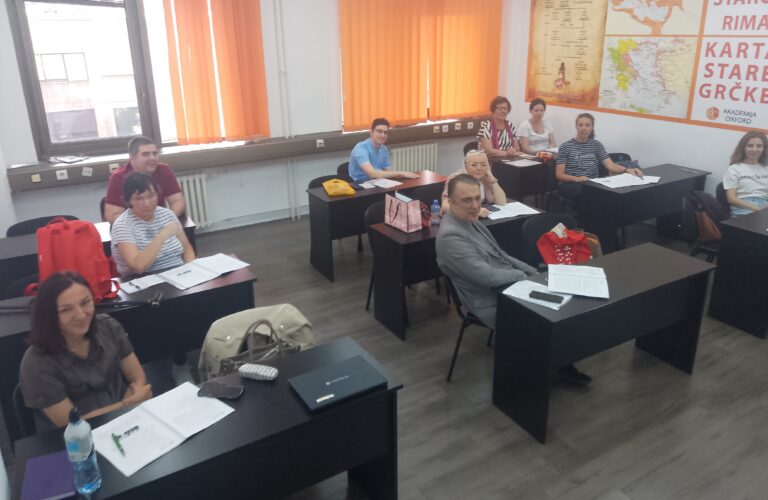
On March 24, 2026, the Center for Democracy Foundation, within the project “Labour Rights and Decent Work in Socio‑Economic Reforms in Serbia – Black on White”, supported by the Olof Palme International Center, organized a public debate entitled “Young People Between Leaving and Opportunity: Can the Youth Guarantee Transform the Labour Market?”.
The discussion featured the following speakers: Jelena Krdžavac Skakić, Ministry of Labour, Employment, Veteran and Social Affairs; Jovan Protić, International Labour Organization; Ljiljana Pavlović, Union of Employers of Serbia; Aleksa Pavlović, Kruševac Educational Center; Jovana Krivokuća Milovanović, Youth with Disabilities Forum; Mirjana Mirosavljević Bobić, Ana and Vlade Divac Foundation; Jelena Stojanović, National Association of Youth Work Practitioners (NAPOR); Milana Sekulić, Ministry of Labour, Employment, Veteran and Social Affairs; Nevena Letić, Knowledge to Work (E2E); and Nataša Vučković, Center for Democracy Foundation. The event was also attended by representatives of the Ministry of European Integration, embassies, trade unions, GIZ, NALED, the Standing Conference of Towns and Municipalities (SCTM), civil society organizations, and the media.
During the public dialogue on the situation of young people in the Serbian labour market, participants discussed the potential of the Youth Guarantee as one of the key youth employment policies in the process of Serbia’s alignment with European social policy standards. Particular attention was given to experiences from the pilot programme currently being implemented in Sremska Mitrovica, Niš, and Kruševac, as well as to plans for nationwide implementation of the Youth Guarantee starting in 2027.
The Youth Guarantee is a programme aimed at ensuring that young people up to the age of 30 receive a quality offer of employment, continued education, training, or an internship within four months of becoming unemployed or completing formal education, thereby facilitating their transition to the labour market and fostering youth employment.
The discussion addressed issues such as young people’s awareness of the programme, results achieved during the pilot phase to date, and challenges related to transitioning from a pilot initiative to a national employment policy. The role of institutions, employers, civil society organizations, and trade unions in ensuring quality and decent jobs for young people was also examined.
Youth employment was recognized as a key issue in assessing Serbia’s economic and social development. Over the past several years, the share of NEET youth (not in employment, education, or training) has remained at around 15%, with young women—particularly those from rural areas and members of the Roma population—being in a particularly vulnerable position.
It was noted that by the end of 2025, more than 19,500 young people had been included in the pilot programme, while around 9,000 youth received a quality offer for continued education, employment, training, or internships. Of these, 6,500 young people received such offers within the four‑month timeframe.
The social dimension of the European integration process was highlighted as being extremely important for the citizens of Serbia. Choosing the European Union also reflects citizens’ expectations that their standard of living and socio‑economic prospects will improve within a differently organized social framework.
The Youth Guarantee was described as a policy that encourages reform and improves the system not only for young people, but for society as a whole. Its implementation requires a range of reforms and initiatives, including strengthening institutional capacities, modernizing the tax administration, ensuring effective labour inspection, improving social services, and adjusting the number and structure of counsellors within the National Employment Service, with specialized training for those working with youth.
It was emphasized that young people are not a homogeneous group, but highly diverse, and that a key challenge in designing youth‑oriented policies is reaching all young people, especially those from multiple marginalized groups. The Youth Guarantee needs to be further tailored to address the specific needs of young persons with disabilities.
Effective implementation of the Youth Guarantee requires cooperation and partnerships among numerous stakeholders, including state institutions, the National Employment Service, employers’ associations, trade unions, civil society organizations, and youth offices. The role of local self‑governments must become stronger and more visible, supported by better planning, coordination, and inter‑municipal cooperation. European Union support was highlighted as particularly important.
The role of civil society organizations was recognized as indispensable, especially youth organizations, whose stronger involvement in employment programmes is needed. Continuous support and more intensive outreach to young people who lack trust in institutions were identified as key factors. For the sustainability of CSOs, programme‑based funding, rather than project‑based funding, was emphasized as crucial. Uneven development of the civil society sector across Serbia remains a challenge, making coordination between CSOs and institutions essential for successful local implementation.
A major challenge identified during the debate is Serbia’s highly centralized education system, which requires a more flexible approach. Limited long‑term planning, rapid technological change, artificial intelligence, shifts in labour demand, and workforce shortages call for adaptive policies. Subsidized employment should be more strongly focused on hard‑to‑employ young people, particularly those with no prior work experience.
In conclusion, it was emphasized that the Youth Guarantee will not resolve all youth employment challenges, but it can significantly support young people’s inclusion and engagement in the labour market. Establishing and strengthening partnerships and cooperation mechanisms at both national and local levels remains essential for the long‑term success of the programme.